Monday, April 12, 2010

More of the Bee Saga


To wrap up the bee saga (and then I promise I'll write about other things) we had another swarm the day after the last time I wrote, but this one actually took off and disappeared after landing high up in the same oak tree again.  (They tend to go back to the same spots because the bees are attracted to the swarming chemical called Nasnoff they let off).  I've since learned that 70% of swarms die.

I went in the hive that night to find out what on earth was going on in there, and to gather questions for a class I had just signed up for (quite timely)  the day all this swarming business started.  I made about a million embarassing mistakes, one being that the pit zips of the rain jacket I use as part of my bee suit were wide open.  I had just started opening up the hive, and it sounded riled up and angry (I should have taken this sign to back away and not attempt an inspection right then, but no, with another another beginner's mistake, I blundered on).   Sure enough, right after I realized there were gaping, unzipped holes underneath my arms, I felt the familiar vibration of bee stuck in fabric.  I managed, after walking away, to get everything off without squashing any bees or getting stung.  

There didn't appear to be a queen present because of a lack of eggs, but there were tons of queen cells (larger peanut looking things hanging onto the side and edges of the comb) which means the hive was raising a new queen and the old one probably took off in the first swarm.  Ironically the night ended with a sting in the armpit after running around the courtyard in the dark shedding jacket, veil and finally my shirt too.  

The hive was very full of comb and surplus honey so I ended up harvesting 2 bars of capped honey comb, which after being pressed and drained through a sieve, was about 2 quarts of honey.    I was ready after this rather difficult hive visit to spend some time learning from an experienced beekeeper, and I greatly enjoyed the class this weekend with  Alan Hawkins, where I did indeed learn tons.

Wednesday, April 7, 2010

Spring Swarming...


Yesterday while I was contemplating chicken coop designs in the backyard, the air was suddenly filled with bees, everywhere, making A LOT of noise.  The had been acting somewhat suspicious (some clumped outside the hive, and just lots more than usual of them around) and apparently they had decided it was time to swarm.  

Luckily, they chose a fairly accessible site at the top of our plum tree.  Well, accessible with our ten foot ladder.  


So... Sasha and I climbed ladders, held a wooden wine box under the clump, shook the branch, and fairly gracefully managed to get most of the bees in the box, which we then left atop the ladder, so the few bees not in the box would find their way back in.


Not the best of ideas, one might guess.  Luckily, when it fell, which it did, it landed intact, in a chair below the ladder, and the inhabitants inside seemed fairly unfazed, at least, they were still there.


We left them overnight, and in the morning transported the box of bees a few miles to our friend's orchard, where we emptied the box that was starting to split at the seams, into a Langstroth bee hive.


Today, from the front yard, we heard a sound that was very much like the sound I heard yesterday in the backyard, and rushed back to find that our hive had decided to swarm again.  After some time, they settled at the very top (way higher than that 10 foot ladder) of the oak tree in our yard, and we called around to various bee keepers to find someone who wanted this swarm.  Just about when one of them showed up (without a ladder) the entire mass took off again, straight back to the original starting place, our hive.  

It is the time of the year when swarming is common.  The hive has raised a new queen, and either the old or new queen(I'm not sure which) and some proportion of the other bees take off in a very organized fashion to find a new home, with scouts going off searching in all directions, and the workers gathered around the queen in a tight ball to protect her.  There is some management of hives to minimize this happening (which we haven't been on top off lately) but it dosn't seem to me like an inherently bad thing, after all, it creates another colony of bees, and increases their population?  More thoughts on this later, along with a hive visit to see what's actually going on in there...

Monday, April 5, 2010

Plants, ducks, and bees gone wild

Home.  There's nothing quite like it.  The housemates have been split across several continents for about the amount of time you might have noticed a lapse in blog posting, while Sasha and adopted housemate Natalie held down the fort.  Actually Lindsay is still gone, and can be found now and then here(if you havent checked it out already): www.healersbydesign.blogspot.com.

There is a brief window of priceless prospective upon returning home, that I have been enjoying the past few days, and could write plenty about.  

But for now I'll just say that I've enjoyed seeing all the changes here on this little piece of land, and seeing which plants have quadrupled in size while I've been away.  


The favas are especially thriving...


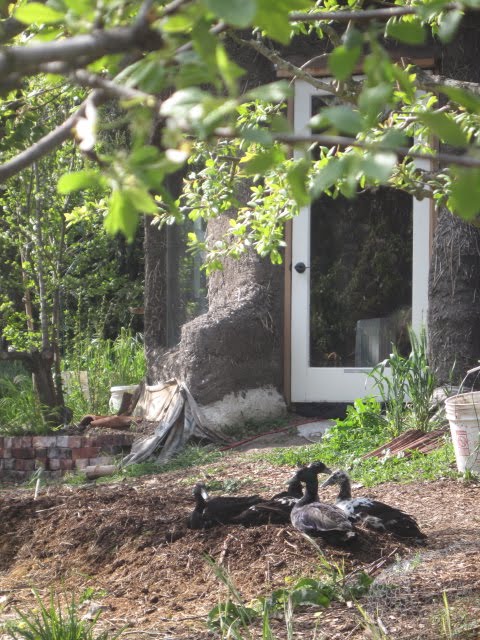
Sasha has been experimenting with letting the ducks loose on our sow bug infestation, and now they are happily enjoying free range of the entire backyard, which is fairly duck safe at the moment since we are focusing on getting 
 
perennials in and there aren't tasty new annual starts for them to nab.  Apparently ducks are able to forage a much greater percentage of their diet than chickens, and while we haven't quite put that theory to the test because we do buy them food, they do seem to be enjoying the free rein, and we are getting eggs again (though that is probably due more to light). 


And then there are our bees, who apparently have decided their old home was too small.  I think I'll save the story for the next post, but the short of it is that our bees swarmed yesterday, and then they swarmed again today... 

Thursday, February 25, 2010

High School Students Plaster the Oven


We had a great group of high school student from Marin Academy spend a day at Villa Sobrante last Sunday. After showing them around, we made pizza in the wood fired cob oven, then plastered the oven with an earthen plaster. I have never had a such an enthusiastic group of teenagers. It was fantastic. It was day one for them of five days of hands on permaculture, after here they headed out to RDI. How wonderful it would be if every teenager had the opportunity to do that, and if even a small percentage wanted to.

Saturday, December 19, 2009

Introduction to Natural Plasters and Paints Workshop

Where: Here at the Villa, El Sobrante, CA (10 minutes north of Berkeley)

When: Feb. 6th & 7th

Cost: $150 per person

$250 for two people signing up together

Includes all materials and lunch both days

Instructors: Massey Burke and Sasha Rabin

For more information contact Sasha at sasha@sgnb.com, or www.sgnb.com

This two day workshop offers a hands-on introduction to working with clay, sand, and fibers to make beautiful, non-toxic plasters and finishes. These methods and materials can be used over conventional sheetrock as well as earthen and straw bale walls. We will process both unrefined and store-bought materials into plaster and paint, and we will apply these finishes over both earthen walls and sheetrock.

Participants will leave the workshop with enough understanding of the materials and process to mix and apply their own paints and plasters on a variety of substrates.

Monday, November 23, 2009

Pods at night... and pictures!

Shortening fall days aren't stopping us yet...  Took my camera around as I was picking up tools. Here is Lindsay mixing up one of the final batches of light straw clay in the granny unit (no, she's not performing a ritual to raise the dead here)

Sasha's rafters.  This is actually pre-roof, so now it looks a little diffferent.... And Massey's woven creation... before it all gets covered up with mud.
It was dark by the time I got all the way to the backyard to my pod, but here are more pictures from the fall, mostly of the buildings.


Sunday, November 8, 2009

Acorn gathering and trailer testing

Midday today, I hauled out the bamboo bike trailer from where it had been sitting under the redwood tree, molding and forgotten.   This post is both a review of its official maiden voyage (finally!), and a rambling account of foraging for and preparing acorns: the amazing nut which was once a food staple for native americans that that falls on the ground this time of year to sprout and create new oak trees, or to be carried off by hyperactive squirrels.  

I built the trailer months ago using this online pattern as a guide- which I highly recommend for its straightforward and clear directions and illustrations.  I bungied a few wooden wine boxes onto it to hold the bounty, and headed off. Well actually, first my bike chain broke, and then the front derailer snapped off in my hand, but the chain was easily fixable and who needs those extra gears anyhow?  Oh bike neglect.  So with a few less gears I pedaled down the road, the empty trailer loosely bouncing along behind me.  I mostly got used to the extra space I took up on the road with it, but I did accidently run over an abandoned rubber rain boot on the shoulder, which flipped the trailer (and luckily caused no harm and spilled no acorns).

Because of the nature of foraging, the trailer filled up gradually, which was an excellent way to test the effect of weight on it.  Bicycle speed suits acorn gathering- fast enough to get from tree to tree, slow enough to see nuts on the ground and pull over for them.  It didn't take long until going up hills was noticably harder and there was quite a bit of pull from behind.  I think all in all I gathered 30-40 lbs (?) from here to Moraga and back which necessitated walking up the steepest hills closest to home, but posed no problem on smallish hills.


So far from my limited experience- Massey and I gathered acorns last year as well, and were given some year-old acorns from friends- it sure seems as if letting them age for a year concentrates flavor and sweetness, though they also do get much harder, so it sounds like you are grinding up rocks when you throw them in the food processor to turn them into meal. 


The jars below contain acorns that have been ground into meal in the vitamix (amazing blender) and covered with cold water to start the leaching process.  In the past I have only done the leaching part with boiling water, which can be done in 30 minutes or so, but this time I am trying it with cold water (which apparently preserves more taste and nutrition, though takes days), draining off the liquid and refilling with fresh water twice a day.  the difference of the two jars here, is that the one on the left is this year's valley oak acorns, and the one on the right is valley oak acorns from last year.
The new acorns (on the left) have a very faint fresh smell, and the year old (on the right) smell like a cross between a good stout and molasses.  I don't know for sure, but I also suspect fermentation with the older acorns, because there is a consistent skim of bubbles on the top.  Anybody know more about this?  When the meal no longer tastes bitter it can either be used immediately or dried in the oven and stored in the fridge or freezer.

Time is running out to gather acorns for the year in the bay area- if anyone is interested in a foraging trip in the next week or two, let me know, I'll be going out again.