Showing posts with label Bees. Show all posts

Monday, April 12, 2010

More of the Bee Saga


To wrap up the bee saga (and then I promise I'll write about other things) we had another swarm the day after the last time I wrote, but this one actually took off and disappeared after landing high up in the same oak tree again.  (They tend to go back to the same spots because the bees are attracted to the swarming chemical called Nasnoff they let off).  I've since learned that 70% of swarms die.

I went in the hive that night to find out what on earth was going on in there, and to gather questions for a class I had just signed up for (quite timely)  the day all this swarming business started.  I made about a million embarassing mistakes, one being that the pit zips of the rain jacket I use as part of my bee suit were wide open.  I had just started opening up the hive, and it sounded riled up and angry (I should have taken this sign to back away and not attempt an inspection right then, but no, with another another beginner's mistake, I blundered on).   Sure enough, right after I realized there were gaping, unzipped holes underneath my arms, I felt the familiar vibration of bee stuck in fabric.  I managed, after walking away, to get everything off without squashing any bees or getting stung.  

There didn't appear to be a queen present because of a lack of eggs, but there were tons of queen cells (larger peanut looking things hanging onto the side and edges of the comb) which means the hive was raising a new queen and the old one probably took off in the first swarm.  Ironically the night ended with a sting in the armpit after running around the courtyard in the dark shedding jacket, veil and finally my shirt too.  

The hive was very full of comb and surplus honey so I ended up harvesting 2 bars of capped honey comb, which after being pressed and drained through a sieve, was about 2 quarts of honey.    I was ready after this rather difficult hive visit to spend some time learning from an experienced beekeeper, and I greatly enjoyed the class this weekend with  Alan Hawkins, where I did indeed learn tons.

Wednesday, April 7, 2010

Spring Swarming...


Yesterday while I was contemplating chicken coop designs in the backyard, the air was suddenly filled with bees, everywhere, making A LOT of noise.  The had been acting somewhat suspicious (some clumped outside the hive, and just lots more than usual of them around) and apparently they had decided it was time to swarm.  

Luckily, they chose a fairly accessible site at the top of our plum tree.  Well, accessible with our ten foot ladder.  


So... Sasha and I climbed ladders, held a wooden wine box under the clump, shook the branch, and fairly gracefully managed to get most of the bees in the box, which we then left atop the ladder, so the few bees not in the box would find their way back in.


Not the best of ideas, one might guess.  Luckily, when it fell, which it did, it landed intact, in a chair below the ladder, and the inhabitants inside seemed fairly unfazed, at least, they were still there.


We left them overnight, and in the morning transported the box of bees a few miles to our friend's orchard, where we emptied the box that was starting to split at the seams, into a Langstroth bee hive.


Today, from the front yard, we heard a sound that was very much like the sound I heard yesterday in the backyard, and rushed back to find that our hive had decided to swarm again.  After some time, they settled at the very top (way higher than that 10 foot ladder) of the oak tree in our yard, and we called around to various bee keepers to find someone who wanted this swarm.  Just about when one of them showed up (without a ladder) the entire mass took off again, straight back to the original starting place, our hive.  

It is the time of the year when swarming is common.  The hive has raised a new queen, and either the old or new queen(I'm not sure which) and some proportion of the other bees take off in a very organized fashion to find a new home, with scouts going off searching in all directions, and the workers gathered around the queen in a tight ball to protect her.  There is some management of hives to minimize this happening (which we haven't been on top off lately) but it dosn't seem to me like an inherently bad thing, after all, it creates another colony of bees, and increases their population?  More thoughts on this later, along with a hive visit to see what's actually going on in there...

Monday, April 5, 2010

Plants, ducks, and bees gone wild

Home.  There's nothing quite like it.  The housemates have been split across several continents for about the amount of time you might have noticed a lapse in blog posting, while Sasha and adopted housemate Natalie held down the fort.  Actually Lindsay is still gone, and can be found now and then here(if you havent checked it out already): www.healersbydesign.blogspot.com.

There is a brief window of priceless prospective upon returning home, that I have been enjoying the past few days, and could write plenty about.  

But for now I'll just say that I've enjoyed seeing all the changes here on this little piece of land, and seeing which plants have quadrupled in size while I've been away.  


The favas are especially thriving...


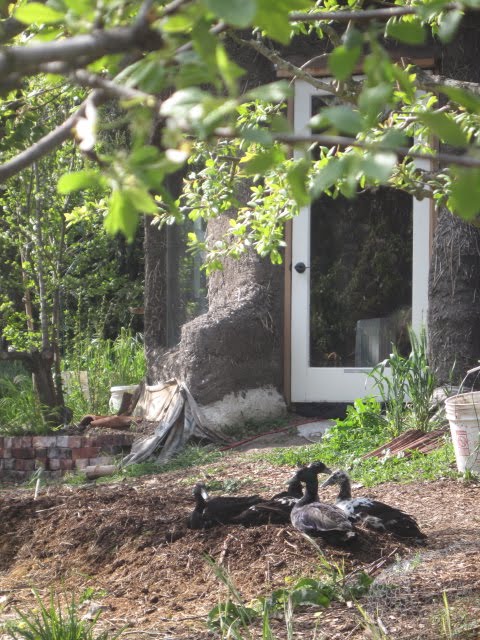
Sasha has been experimenting with letting the ducks loose on our sow bug infestation, and now they are happily enjoying free range of the entire backyard, which is fairly duck safe at the moment since we are focusing on getting 
 
perennials in and there aren't tasty new annual starts for them to nab.  Apparently ducks are able to forage a much greater percentage of their diet than chickens, and while we haven't quite put that theory to the test because we do buy them food, they do seem to be enjoying the free rein, and we are getting eggs again (though that is probably due more to light). 


And then there are our bees, who apparently have decided their old home was too small.  I think I'll save the story for the next post, but the short of it is that our bees swarmed yesterday, and then they swarmed again today... 

Friday, September 4, 2009

Honey Harvest and Bearding Bees


This week we harvested our first honey from the bees.  They have nearly filled the hive completely with comb, and we wanted to go in and check on their progress, and see if anymore queen cells had been built.  These are larger cells that hang down from the side of the comb where they raise new queens, and it means they are thinking about swarming. Generally we want to reduce the amount they swarm.  We also wanted to make sure all the comb was growing straight down.  A few queen cells were found and removed, and some comb near the end of the hive was curving into a neighboring comb, making the frames difficult to remove.  

We ended up removing an entire frame that was full of capped honey at the top, and nectar on the bottom (not completely dried by the bees yet, or capped) to create some more room, and we cut out the sections that were growing crookedly.  This provided us with about a pint and a half of honey and it is delicious!  Someone had the excellent idea of saving a small amount of it to compare to future harvests and see what different seasons taste like around here.  

Later in the day we were startled to see the bees congregating on their "front porch" (picture above) and were concerned that they might be swarming.  We have since found out that perhaps they were "bearding" which means basically going outside to hang out when the weather is hot and they want more space and ventillation.  

Saturday, May 2, 2009

Spring rains and micro-livestock

It has been a while since anyone has written, and since I've been holding down the home front recently, I guess its my turn to catch up a bit.  I'm still getting used to this blogging stuff.   Out the window, it looks like our garden is enjoying this late spring rain as much as I am.  Continuing to prep garden beds and trying to make/find places for all the seeds we want to plant and all the seedlings Lindsay brings from the nursery is a big job these days.  I’ve also been trying to get soil building systems in place to help transform our heavy compacted clay soil into rich loamy garden beds.  The good news is the army of gigantic earthworms that seem to reside just below the crust (the soil can't be that bad) the bad news is the layers of gravel, black plastic, broken glass and trash one has to dig through in our yard to find these guys.   Our red wiggler compost worms have moved up in the world, out of their too-small wooden box into a bathtub, where we can collect the casting tea from the drain(pure gold to the plants) and we've been building and turning compost piles in the back, honing methods and observing transformations from duck poop, straw and kitchen scraps into steamy black compost.

No one has fully mentioned the honeybees yet, so maybe this is a good time to do that, especially since they are part of what I affectionately refer to as our micro-livestock collection. The earlier pictures I posted show the top bar hive that Sasha built.  Spring is when bees swarm, which, for those of you who aren’t familiar with bees, is when part of the hive leaves with the queen bee in search of a new home.  This is the natural ways for bee colonies to grow and create new bee colonies, and it also happens if they outgrow their current space.  The bees are vulnerable because they have no home, and only have as much food as they’ve eaten before swarming.  As a result they are fairly docile in this state as they conserve their energy.

I had a near miss catching a hive, which is a story in itself, but luckily Sasha had success, and helped a friend prune a rosebush to access the hive swarming inside of it.  The short story is that the bees all ended up in a wooden box with holes punched in it, and early in the morning, still half in our pajamas, we emptied the box into the hive.  It was amazing to watch the bees literally pour into their new home, and to see that they had already started building new comb overnight in their temporary abode.

  We’ve opened up the hive once since then to see how they are doing.  Apparently all is well, as far as I know, which isn’t all that much, because they are still there and are building arch shaped combs that hang down from the bars of wood that sit across the top.  We were able to distinguish between workers and drones (workers are all females that can’t produce eggs but do practically everything else, and drones are males that mate with the queen and then die).   The drones have big eyes (for spotting the queen when she flies high up in the sky to mate).  Its been great fun to go sit by the hive every now and then and watch the buzz of activity.  It seems like about 20 % of the bees flying in have gigantic yellow blobs of pollen on their back legs (which is where the saying “the bees knees” comes from because they have an interesting pollen storage system around their knees).

  Ok, that’s it for now- time to go see if the ducks are behaving themselves- they are out free-ranging in the yard this morning!