Showing posts with label Garden. Show all posts

Friday, June 22, 2012

Hugelkultur experiments: Amped-up sheet mulch

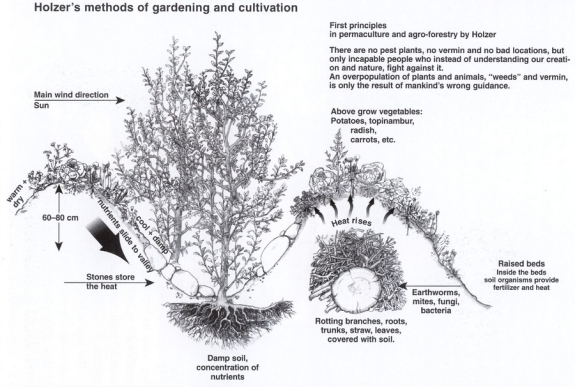
Hugelkultur, which is German for "hill-culture," is basically a fancy term to describe a way of building soil using rotting wood and excess branchy material.   The technique is to throw your rotting logs, branches, brambles, into a pile (or a dug out trench) and cover them with smaller material- leaves, sod, etc, and some soil on top.  The outcome is a garden bed that holds onto water for longer, has a slow steady input of nutrients from breaking down organic matter, is full of air channels that feed soil life, and create microclimates.

Building soil has been topmost priority in the garden here-- as quite literally what was here was "building" soil, heavy, compacted clay--  and I was reminded of how far we've come yesterday as I was digging in an area I had not yet dug in, to prepare for the building of a deck on the granny unit.   My pick ax bounced off the hardened familiar layers of compacted clay soil, gravel, and black plastic and I was oh so grateful that those familiar layers are now mostly gone from the back yard after years of digging them out and adding organic matter.  I'm not sure what the reasoning behind it was... weed control perhaps? but its had the effect of doing exactly the opposite of what healthy soil should be doing.   Anyhow, continuing to ask the question of how to build soil appropriately brought up hugelkultur, a term I'd first heard from our neighbor down the street.

Here is a nice sketch of an example of hugelkultur from Sepp Holtzer.

Our branch pile has been growing this spring from pruning, and rather than let it take over the yard or figure out what else to do with it, throwing it back into the soil to try another sheet mulch system seemed like the perfect solution.

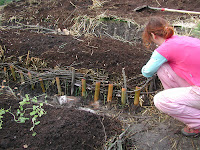
I altered the implementation of the hugels here from what I'd read based on available materials, and thoughts about climate.  The rotting logs were omitted (didn't have any), and rather than mounding them up-- which seemed like a way to lose moisture in this climate, at this time of year-- we dug out trenches and filled them- so hopefully they'll act like swales, to capture rainwater, in the winter as well.  So perhaps it would be more accurate to call them amped up sheet mulched beds, not hugels.


A month or so into the existence of these beds, my thoughts are that one, rotting wood is perhaps an important ingredient as something that already has sufficient moisture in it, and two, timing of implementation is important, especially in dry climates like this one.  My hunch is that the two hugels here might actually need MORE water, to get going, because they were one, built with branchy material, and not much in the way of logs, and two, built just as northern California is entering the time of year where things start getting really dry- from wind, sun, and lack of rain.

The sheet mulched beds we've created here in the past supports the timing hunch- the ones that were created during or prior to the rainy season seemed to get a better start.

More observations and experiments with soil building to come...

Thursday, June 7, 2012

Plant obsessions, garden questions, and BEANS.

After a long hiatus I'm back to write a post.  I apologize for the lapse, and now I return, clearer on what to use this space for.  I enjoy taking pictures, I enjoy sharing them, and I enjoy the space to try to put down in words and evolve some of the thoughts that run though my head as I turn the compost, or plant a row of beans, or stand in the raspberry bushes grazing.  Basically it acts as a space to continue to try to answer the question why do this?  Why put energy into digging up soil and turning it into homes, or habitat for quinoa plants?  Why spend the time and energy planting, watering, weeding, and then figuring out the best ways to store and cook beans, or jerusalem artichokes, or tomatoes, or onions?  So hopefully this blog will go back to being somewhat regularly updated as a space to share our experiences here as food for thought with others who are interested and care to read.  Meanwhile, it seems technology continues on, and blogger has added all sorts of new options that make blogging more user friendly, so I'm having fun re-vamping the blog aesthetically and structurally....

Berries and rhubarb.... pie time!
It seems like every year I have a favorite plant that I get rather obsessed with, and try to squeeze into every corner of the garden, and start to convince myself why it is the THE PLANT that makes sense to grow, here in El Sobrante, and here, on this little plot of land (and really, I don't think monoculture makes sense or works). Last year it was quinoa (the obsession isn't over) and this year I'm not sure, but this week it's tilting towards dry beans.  After a late start getting the garden going this spring, it is mostly planted out, and the remaining open spaces are getting filled with beans. Vine beans, bush beans, any sort of bean that will make an interesting and abundant crop of dry beans, to cook in the solar oven this winter or next year.  Scarlet runners are a favorite in my limited bean repertoire so far, mainly because they are so darn abundant, and the beans are so huge.  I like the taste of the dry bean too, but there are mixed reviews as far as that goes.  And, they don't seem very picky.  In fact, there are volunteer scarlet runners all over the place where I planted them last year.  I've planted them around my pod, and intend to grow them into a living curtain (pictures to come).
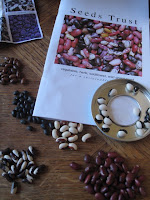
some seed from last year- "farro" quinoa and runner beans

Other beans in the ground this year:  Cherokee Trail of Tears Black Beans, Vermont Cranberry, Tepary, Lazy Housewife, Bumble Bee and Ireland Creek Annie.  The last two are bush varieties.

My intent, as with most crops I get obsessed with, is to find out if its possible to grow the amount needed to sustain the household's-- in this case, bean intake-- until next years crop.

Onion harvest drying. harvest: approx 100 onions for 50 sq ft. Planted Dec, harvested May.
Because circling back to that question- why do this- I'm continually trying to get clearer on what are the important questions to ask when considering what to plant and how to go about planting it, in a home scale garden, in the context of our current agriculture systems and world today.

A few thoughts...
Considering energy of growing it somewhere else- transportation, dubious growing means, etc, vs growing it at home- what are the crops you can grow at home- and not have to spend much energy on growing, or limited resources (like water), and be able to make a significant impact by growing your household's needs worth of, for the year?  Quinoa was a favorite here because of its very low water needs, and needs in general, as a crop.  Add to that the yummy nutritious greens (20 percent protein content) and high yield of seed per plant (as much as a cup!) I was smitten.

And then the thought of how to use space wisely.  In my scarlet runner bean planting I've been trying to put them places where I already water, and where there are already things for them to climb on- buildings, fences, etc.  And hopefully, there will be benefits (like curtains, and less energy to move hose or less water needed) to reap from smart placement...

Coming soon, Hugelkulture!

And here's just a fun picture of the oven which got some maintenance recently after a little bit of winter rain damage.  I think if we made maintenance more fun and creative, it would be easier to do, don't you think?


Sunday, June 27, 2010

Exciting Harvests


Summer... The days have been chilly and windswept as the fog rolls in and out.  Ah the Bay Area.  Today was hot and sunnny, and it was a lovely reminder of what summer means some places.  Here are some pictures of exciting harvests we've had lately that I just have to share:


There are so many dried favas. Plenty to have for planting this winter, and some to eat too.  I've never cooked dried favas before.  

Potatoes are sooo much fun to harvest.  These were pink inside too, large and delicious and there are more out there.

Also, three kinds of citrus.  Only a few fruit per tree at the moment, but they are young trees, and guess what?  They are delicious!  We sampled this navel orange, and a mandarin that were sweet and juicy and sun-warmed scrumptiousness. 


The bittersweet harvest was the beehive.  After all that crazy swarming this spring, looks like our hive didn't make it.  So lots of beeswax to clean, honey to drain, mead to ferment, pollen to pick out of the comb.  Glad we caught one of the swarms.  Now to figure out what happened.

And there is loads of garlic.  About 5 different kinds, currently, hanging in the unfinished closet in my house in the back yard drying as it's a relatively shady/cool/out of the way spot.  


Saturday, June 5, 2010

Why I Garden


Last night I went to a seed saving talk with Bill McDorman, the man most famous for traveling to Siberia in 1989 in search of plant diversity.  Behind the Iron Curtain he found a world cut off from the influences of industrial agriculture, growing more varieties of tomatoes than anywhere else in the world out of true necessity to feed themselves.  

It was a passionate and facinating talk and a good reminder of why I garden.  Sure, there are many reasons.  I like planting seeds, watering them, watching them grow and then getting to eat fresh food out of my own garden.  It's fun.  I like being outside.  But Bill reminded me of the importance the work of a gardener holds for the future, and the startling numbers which  I've heard before, and often forget because my mind dosn't seem to hold onto numbers like that.  That we relied on 1500 plants for food in the 1900s.  That in the 80s, 30 plants contributed to 90% of our food, and just 4 of those plants, to 75 % of our diet.  And now?  Half of our calories in all of America come from soda.  Yep, soda.  And what's in that?  Corn syrup.  Corn.  Where are we going from here?  Where can we go from here?

Though the facts are depressing-- that we are making a rapid transition from a history of 10,000 years of genetically diverse agriculture to a agricultural system that relies on only a few species grown with chemicals and genetic modification and things such as terminator genes which mean the farmer can't possibly save seed but has to buy them again from the seed company-- the reminder was important.  As a gardener, the way to protect our food source and survival for the future is to continue to grow as many varieties as possible, and to save that seed.  I don't want to just eat corn.   And besides the fact I don't want to, what's going to happen when diseases wipe out this one major crop- more susceptible as a single species than diversity.  

Today, newly inspired and still in the spring rush to plant plant plant, I dug through our seed box and came up with a little jar of about a dozen varieties of dried beans that my aunt had given me for Christmas years ago (thanks Irene!), and I hadn't really gotten around to planting huge numbers of yet for various reasons even though I thought it was the coolest gift ever.  They are absolutely beautiful and have names like Yin and Yang and Vermont Appalousa and are all different colors and sizes.  I planted up half or more of each type.  Yeah our garden is filling up, but there is always more space.  An overwhelming amount of space at times to take care of, plant, water, harvest from... but I can't think of many more important things to do with this little piece of land than build topsoil and plant and save seeds.

We are lucky to have BASIL,  a seed saving library based out of the Ecology Center down in Berkeley, that I haven't made full use of but am glad to know exists, and last night I was just alerted to maybe the first ever seed library that is in an actual library, out this way in Richmond- the Richmond Grows Seed Lending Library.  Check it out!  Or if you don't live here... save some seeds, plant them again, give some to your neighbor... start your own seed library?

Friday, August 7, 2009

Summertime bounty

How's this for a garden update?

(challenge... count how many duck eggs are hiding among the lemon cucumbers)

Tuesday, March 17, 2009

Radishes: instant gratification!

I've grown radishes so many times, all the way back to when I was just a kid  squatting in my mom's garden and plunking seeds into holes, yet they will never cease to amaze me.    I gathered my first handful of radishes from our garden here today, and was filled with the same sense of excitement and awe I felt the very first time I ever harvested something.  I had to run around with the bouquet of brilliantly colored roots, a wild grin on my face, showing everyone the bounty.  They really are a gardener's instant gratification, easy and quick to grow,  beautiful to harvest, and deliciously crunchy and simple to eat right away sprinkled with salt.  

The soil here is heavy clay, great for our building projects, not so great for gardens,
so there are various ways we have been experimenting with building our soil and creating garden beds.  Today with the help of some volunteers, including our first traveling visitors(all the way from England and Ireland!), and our 9-year old neighbor (probably our biggest fan), we dug a couple of swales and built up two new garden beds in the back yard, using a method from  Toby Hemenway's book Gaia's Garden.   After using picks and shovels to break up the clay, we built up the following layers, wetting them thoroughly in the process:  
1) nitrogen, in the form of grass clippings a volunteer kindly clipped from the most lush place in our yard where the grass grows tall; 2) a layer of cardboard to suppress any grass seeds/weeds from growing through; 3) another layer of nitrogen, this time in the form of local horse manure; 4) flakes of straw laid out to be about 3-4 inches thick though double that would have been great had we had more straw; and lastly 5) a few inches of finished compost, that if deep

enough, makes it possible to go 
right ahead with planting while all the layers underneath decompose slowly overtime as roots and microorganisms make their way through.  We are wondering how root crops like beets and
 carrots will like this method.