Wednesday, November 28, 2012

First Annual Bean Tasting


A few weeks ago we hosted a side by side sampling of all these beans.  I thought it would be fun to see how different they actually tasted.  Turns out, not that different.  Well, no, a little bit different, and of course some are bigger and some are smaller and some are meatier and some are squishier.  I wish I took a picture of the table with the full spread, but this is all I have.  

The total yield for the year ended up being around 9 quarts of dry beans.  That was from a few scarlet runner vines, four approximately 8 foot rows of bush beans (bumble bee and ireland creek annie), a bamboo teepee overrun with cherokee trail of tear black beans,  a cucumber trellis with a few cherokee trail of tear black beans on it, and a 2-dimensional bamboo teepee of lazy housewife beans squeezed into a bed already full of zucchini, peppers and basil (but mostly zucchini, you know how that goes!)

I still love the scarlet runners.  They are just so big and I love the texture.  Not to mention the yield per one vine... tons! And they are so pretty soaking (below).  But the black beans really did taste more flavorful and fresher to me than black beans you buy in the store. Hopefully this is the first of many more annual bean tastings! Grow some to bring and share next year...


Monday, July 2, 2012

photos

My mom and sister visited last week to help build a deck/landing for the door on the backside of the granny unit.  Besides being a fun and helpful deck crew, they both have a good eye for photos, and its refreshing to see the site through new eyes.  Here are some of their photos, showing what the structures in the backyard look like these days...


Living paving: salvaged blocks/bricks from site and chamomile


Friday, June 22, 2012

Hugelkultur experiments: Amped-up sheet mulch

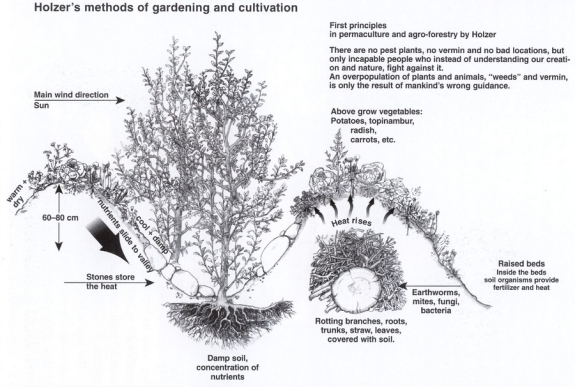
Hugelkultur, which is German for "hill-culture," is basically a fancy term to describe a way of building soil using rotting wood and excess branchy material.   The technique is to throw your rotting logs, branches, brambles, into a pile (or a dug out trench) and cover them with smaller material- leaves, sod, etc, and some soil on top.  The outcome is a garden bed that holds onto water for longer, has a slow steady input of nutrients from breaking down organic matter, is full of air channels that feed soil life, and create microclimates.

Building soil has been topmost priority in the garden here-- as quite literally what was here was "building" soil, heavy, compacted clay--  and I was reminded of how far we've come yesterday as I was digging in an area I had not yet dug in, to prepare for the building of a deck on the granny unit.   My pick ax bounced off the hardened familiar layers of compacted clay soil, gravel, and black plastic and I was oh so grateful that those familiar layers are now mostly gone from the back yard after years of digging them out and adding organic matter.  I'm not sure what the reasoning behind it was... weed control perhaps? but its had the effect of doing exactly the opposite of what healthy soil should be doing.   Anyhow, continuing to ask the question of how to build soil appropriately brought up hugelkultur, a term I'd first heard from our neighbor down the street.

Here is a nice sketch of an example of hugelkultur from Sepp Holtzer.

Our branch pile has been growing this spring from pruning, and rather than let it take over the yard or figure out what else to do with it, throwing it back into the soil to try another sheet mulch system seemed like the perfect solution.

I altered the implementation of the hugels here from what I'd read based on available materials, and thoughts about climate.  The rotting logs were omitted (didn't have any), and rather than mounding them up-- which seemed like a way to lose moisture in this climate, at this time of year-- we dug out trenches and filled them- so hopefully they'll act like swales, to capture rainwater, in the winter as well.  So perhaps it would be more accurate to call them amped up sheet mulched beds, not hugels.


A month or so into the existence of these beds, my thoughts are that one, rotting wood is perhaps an important ingredient as something that already has sufficient moisture in it, and two, timing of implementation is important, especially in dry climates like this one.  My hunch is that the two hugels here might actually need MORE water, to get going, because they were one, built with branchy material, and not much in the way of logs, and two, built just as northern California is entering the time of year where things start getting really dry- from wind, sun, and lack of rain.

The sheet mulched beds we've created here in the past supports the timing hunch- the ones that were created during or prior to the rainy season seemed to get a better start.

More observations and experiments with soil building to come...

Thursday, June 7, 2012

Plant obsessions, garden questions, and BEANS.

After a long hiatus I'm back to write a post.  I apologize for the lapse, and now I return, clearer on what to use this space for.  I enjoy taking pictures, I enjoy sharing them, and I enjoy the space to try to put down in words and evolve some of the thoughts that run though my head as I turn the compost, or plant a row of beans, or stand in the raspberry bushes grazing.  Basically it acts as a space to continue to try to answer the question why do this?  Why put energy into digging up soil and turning it into homes, or habitat for quinoa plants?  Why spend the time and energy planting, watering, weeding, and then figuring out the best ways to store and cook beans, or jerusalem artichokes, or tomatoes, or onions?  So hopefully this blog will go back to being somewhat regularly updated as a space to share our experiences here as food for thought with others who are interested and care to read.  Meanwhile, it seems technology continues on, and blogger has added all sorts of new options that make blogging more user friendly, so I'm having fun re-vamping the blog aesthetically and structurally....

Berries and rhubarb.... pie time!
It seems like every year I have a favorite plant that I get rather obsessed with, and try to squeeze into every corner of the garden, and start to convince myself why it is the THE PLANT that makes sense to grow, here in El Sobrante, and here, on this little plot of land (and really, I don't think monoculture makes sense or works). Last year it was quinoa (the obsession isn't over) and this year I'm not sure, but this week it's tilting towards dry beans.  After a late start getting the garden going this spring, it is mostly planted out, and the remaining open spaces are getting filled with beans. Vine beans, bush beans, any sort of bean that will make an interesting and abundant crop of dry beans, to cook in the solar oven this winter or next year.  Scarlet runners are a favorite in my limited bean repertoire so far, mainly because they are so darn abundant, and the beans are so huge.  I like the taste of the dry bean too, but there are mixed reviews as far as that goes.  And, they don't seem very picky.  In fact, there are volunteer scarlet runners all over the place where I planted them last year.  I've planted them around my pod, and intend to grow them into a living curtain (pictures to come).
some seed from last year- "farro" quinoa and runner beans

Other beans in the ground this year:  Cherokee Trail of Tears Black Beans, Vermont Cranberry, Tepary, Lazy Housewife, Bumble Bee and Ireland Creek Annie.  The last two are bush varieties.

My intent, as with most crops I get obsessed with, is to find out if its possible to grow the amount needed to sustain the household's-- in this case, bean intake-- until next years crop.

Onion harvest drying. harvest: approx 100 onions for 50 sq ft. Planted Dec, harvested May.
Because circling back to that question- why do this- I'm continually trying to get clearer on what are the important questions to ask when considering what to plant and how to go about planting it, in a home scale garden, in the context of our current agriculture systems and world today.

A few thoughts...
Considering energy of growing it somewhere else- transportation, dubious growing means, etc, vs growing it at home- what are the crops you can grow at home- and not have to spend much energy on growing, or limited resources (like water), and be able to make a significant impact by growing your household's needs worth of, for the year?  Quinoa was a favorite here because of its very low water needs, and needs in general, as a crop.  Add to that the yummy nutritious greens (20 percent protein content) and high yield of seed per plant (as much as a cup!) I was smitten.

And then the thought of how to use space wisely.  In my scarlet runner bean planting I've been trying to put them places where I already water, and where there are already things for them to climb on- buildings, fences, etc.  And hopefully, there will be benefits (like curtains, and less energy to move hose or less water needed) to reap from smart placement...

Coming soon, Hugelkulture!

And here's just a fun picture of the oven which got some maintenance recently after a little bit of winter rain damage.  I think if we made maintenance more fun and creative, it would be easier to do, don't you think?


Monday, July 18, 2011

A photographic update

Here's some of the latest around here...

Marbled purple stripe garlic


Sanding the floor in the granny unit

Quinoa in bloom

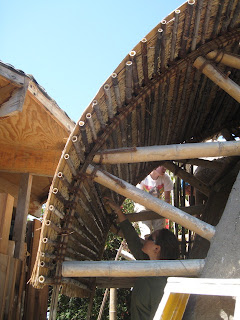
Working on Massey's bamboo and lime roof


Tuesday, June 28, 2011

A local grain infrastructure?

The flour in these bags comes from wheat that was grown 65 miles from the Bay Area in the Capay Valley. It was milled and packaged in San Francisco by Giustos, a family run milling company that is amenable to processing and storing the currently rather small amounts of this local wheat, and came to our house by way of a woman named Monica Spiller who has been working to connect local farmers with appropriate grain seed for our area, and the wheat itself to bakers and eaters.


We are so accustomed in the Bay to hearing about local food and growing our own greens and tomatoes and knowing where our eggs and cheese comes from. However grains, a large proportion of our diet, are mostly still part of a large system these days, and even in this mecca of local foodism one can't necessarily find local grains without a bit of a search.

Our current grain system, from the growing of wheat, to the processing, shipping and eating of it, compromise and degrades soil health, uses many fossil fuels in growing and transportation, and lacks the nutritional benefits in the final product becoming a food that no longer is full of the health giving properties it once had, but now makes us sick.

I recently learned that the protein content of wheat is directly proportional to the health of the soil it was grown on, and thus the 12-13% protein of this Sonora wheat, compared to 7% of conventional white flour these days, is an interesting figure to consider.


It's quite exciting to have this pile of flour bags sitting in our living room, ready to be distributed to a number of friends, neighbors, and a restaurant, because it's the sign of an infrastructure of an appropriate size being rebuilt.

And of course, the thought of delicious bread to come...


If you are interested in becoming part of a regular buying club of local organic flour and pasta, or want to start your own, email me at trilibite (at) hotmail.com

The Whole Grain Connection is a wealth of information including recipes, history,
and lots of information about various wheat varieties: www.sustainablegrains.org

Monday, February 14, 2011

Permaculture Design in Lake County

Villa Sobrante resident Massey Burke has been working in Lake County for the last several years, bringing natural building to the community through public projects.

This spring, Villa Sobrante resident Lindsay Dailey will be working in Lake County as well, teaching a Permaculture Design Certificate (PDC) course. Permaculture offers the framework, tools and methodologies to work with and within natural systems to create beneficial change. Those who learn these skills have the potential to transform a garden, a farm or even a community. Many have found this course to be one of the most beneficial courses they have ever taken and the skills are invaluable.

Transition Lake County, Dancing TreePeople Farm, LakeFuture, and Edge Ecology will host the PDC in Upper Lake this spring over 5 weekends:

April 16 &17
April 30 & May 1
May 14 & 15
May 21 & 22
June 4 & 5

For more information, email Lindsay@EdgeEcology.com or visit http://www.lakefuture.blogspot.com/.

Monday, September 27, 2010

The newest pod

Somehow 2 months have gone by since I've written a thing. I'll start with the newest structure that has popped up in the backyard village. It all started with a lot of these:

I believe around 700 to be exact.

These adobes- just soil, sand, straw and cow manure- were made to go into a structure called a Nubian Vault, which is a style of earthen vault building revived by the Eygptian architect Hassan Fathy that does not use any formwork, and therefore can be done without any wood. Our friend Stevan who studied the technique with masons in Burkino Faso was looking for places to build some of these vaults where they could be observed over time, and we gladly gave a portion of our yard for the purpose of vault research, and to make a stylish new home for our expanding flock of poultry.

Here we are looking through the front door to the back kick wall. These two kick walls were built prior to the workshop and are the walls that the adobes will lean against to make up the vault. The little box is the future chicken door.
Here the plumb bob is being used to transfer the dimensions of a catenary arch onto the kick walls. It is the shape the vault will follow, and is the inverted shape of a chain hanging between two points. Guide strings will be strung along the length of the building between the traced out form on both kick walls.

Stevan demonstrates the angle at which to lay the first adobes that will make up the vault during the workshop.

You can see the walls growing as the process gets further along. It was an extremely graceful structure to watch emerge.

And more still... you can see the angle of the rows of adobes clearly here.
Here you can start to see what happens in the middle when the different angles from the two ends come together in the middle.

Meanwhile the girls are checking it out from their old coop next door. They've started laying eggs, we're getting 6-7 a day from 10 chickens, ranging from tiny "practice eggs" to larger double yolkers. Unfortunately they've also started eating the duck eggs...

More pictures and updates coming soon!


Monday, July 26, 2010

Visitors from India


Last week we had the opportunity to host two men from the western state of Gujarat, in India, at our house.  It was their first time to the states, and we were honored that they chose to spend time at our house in El Sobrante of all places.  It is a long story how they ended up here, but the short of it is that Massey and I met Himansu briefly in India this winter, and told him to stop by when he came to the states.  Himansu was traveling with Ramu, an artisan from a tiny rural village who makes quilts, to an international craft fair in Santa Fe.

Himansu runs a textile business that employs Ramu and other quilters and embroiders from Gujarat, but does lots of other things too, like record tribal folk music in earthen buildings in Gujarat and Rajastan.  Ramu is also skilled at many things.  He declared our site soil to be a wonderful clay and proceded to show us how to do Lipon- the traditional Gujarati way of doing decorative earthen work on walls.  He dosnt' speak English (save for a few words) and we learned limited Gujarati in the past week so communicating was a delightful challenge, and mostly done through Himansu, who translated.

Below is Ramu, in our clay soaking pit, processing our site soil, and horse manure, to make Lipon with.

This became a great opportunity to work on the wall-- that has been sitting rather unfinished out front for a very long time-- so an early morning plastering session turned it red, from some clay soil somebody brought back from up north.


Next, Ramu showed us how to do Lipon, by rolling snakes out of a careful mixture of clay soil, screened dried horse manure, wood glue and water, and pinching them tightly to the wall.

Over the course of about 3 or 4 days, we had lots of helpers, and lots of gawkers, and met more of the neighborhood than we'd previously met, because pretty much every body who passed by was compelled to stop and comment or ask questions.
The pattern was drawn by Massey and inspired from a bed sheet with an old Mogul pattern she'd originally picked up from Himansu in Gujarat.  Himansu calls it "nervous elegance" referring to the drooping flowers that are scattered throughout Mogul designs.  I liked his description.

We removed some of the bamboo and used base plaster to sculpt designs in the openings, a method also inspired by Gujarat.  Mirrors are often embedded in the design, though for our wall we decided against mirrors and instead used mica, which was traditionally used before mirrors.  It looks beautiful.

More pictures to come.  The roadside is now complete as well, and the roof is next to protect all this fine work...

Thanks to everybody who helped with this intricate work and a big thank you to Ramu and Himansu as well.

Oh and one last picture for your amusement... the bamboo trailer wasn't quite up to the bicycle rickshaw standards of India, but we thought we'd give it a go for airport transportation :)

Sunday, June 27, 2010

Exciting Harvests


Summer... The days have been chilly and windswept as the fog rolls in and out.  Ah the Bay Area.  Today was hot and sunnny, and it was a lovely reminder of what summer means some places.  Here are some pictures of exciting harvests we've had lately that I just have to share:


There are so many dried favas. Plenty to have for planting this winter, and some to eat too.  I've never cooked dried favas before.  

Potatoes are sooo much fun to harvest.  These were pink inside too, large and delicious and there are more out there.

Also, three kinds of citrus.  Only a few fruit per tree at the moment, but they are young trees, and guess what?  They are delicious!  We sampled this navel orange, and a mandarin that were sweet and juicy and sun-warmed scrumptiousness. 


The bittersweet harvest was the beehive.  After all that crazy swarming this spring, looks like our hive didn't make it.  So lots of beeswax to clean, honey to drain, mead to ferment, pollen to pick out of the comb.  Glad we caught one of the swarms.  Now to figure out what happened.

And there is loads of garlic.  About 5 different kinds, currently, hanging in the unfinished closet in my house in the back yard drying as it's a relatively shady/cool/out of the way spot.